
Inside Space Money Alpha, the mysterious stealth model taking on GPT‑6
A mysterious new AI model has quietly appeared on OpenRouter and OpenCode, and it’s already turning heads. It’s called Space Money Alpha, it’s completely free during its preview, and in several real-world coding and 3D tests it has gone toe-to-toe with GPT‑6-level models—sometimes even beating them on quality.
What is Space Money Alpha?
Space Money Alpha is an anonymous, third‑party large language model that’s being exposed through platforms like OpenRouter and OpenCode. The provider behind it has chosen to stay completely unnamed during this preview phase, so nobody knows who actually built it.
OpenRouter and OpenCode don’t own or operate the model. They simply route your requests to the hidden provider, which is why it’s often described as a “stealth model.”
Key features at a glance
Based on early testing, Space Money Alpha comes with an impressive feature set:
- Huge context window: Up to 1 million tokens, allowing it to handle massive projects, long codebases, and complex multi-step tasks.
- Blazing fast generation: Around 70–120 tokens per second in many tests, with roughly 1.5 seconds of initial latency.
- Adjustable reasoning effort: You can dial up the “reasoning” level for harder tasks. Higher reasoning gives better quality but can dramatically increase total run time.
- Native multimodal input: It can take images and video clips as input and use them to generate code, 3D scenes, and more.
- Strong coding & web dev skills: Especially good at complex front‑end, 3D experiences, and interactive UI work.
Is it a Minimax model? Probably not.
Early on, many people suspected Space Money Alpha might secretly be a Minimax M3‑series model. One of the biggest clues was that it appeared to use the same tokenizer as the Minimax M3 family.
However, that theory fell apart once Minimax officially released the M3.1 Flash model. Space Money Alpha is still live as a separate, anonymous model, and its behavior and performance don’t fully match M3.1 Flash. For now, its origin remains unknown.
How fast is it really?
In normal usage, Space Money Alpha feels extremely fast—often even quicker than Minimax M3.1 Flash, which is specifically optimized for speed and efficiency. Latency and throughput numbers reported include:
- Initial latency: ~1.5 seconds before the first token (in default modes).
- Generation speed: ~74 tokens per second in one test, and up to ~120 tokens per second in a large coding run.
However, once you crank the model to max reasoning, things change. The raw token speed stays high, but the model spends a lot more time “thinking” and planning, so big projects can stretch into 30–60 minute runs. You’re trading time for depth and quality.
Space Money Alpha vs GPT‑6 Astra on a complex 3D project
One of the most eye‑opening tests put Space Money Alpha directly against GPT‑6 Astra on a demanding 3D web task. Both models received the exact same prompt:
Build a fully detailed box‑style Japanese garden in Three.js, with a pagoda, tiny villagers, a flying dragon, and interactive elements.
Here’s how the two models compared:
- Space Money Alpha
- Time: ~45 minutes
- Cost: Free (during preview)
- Result: Highly detailed scene, with strong attention to small interactions and requested elements.
- GPT‑6 Astra
- Time: ~15 minutes
- Cost: About $424 in generation costs for this single run
- Result: Good, but reportedly less detailed and less faithful to the full prompt than Space Money’s output.
Despite taking longer, Space Money Alpha delivered a richer, more complete implementation—and did it at zero cost. If you’re exploring Astra’s 3D capabilities, you might also want to compare this with the analysis in this deep dive into GPT‑6 Astra and 3D modeling.
Real-world coding tests with Space Money Alpha
To see what the model can actually build, testers wired Space Money Alpha into a coding agent (like Kilo Code inside VS Code) and pushed it through a series of front‑end and 3D challenges, usually with reasoning set to max.
360° product viewer with interactive hotspots
First, Space Money Alpha was asked to create a 360‑degree rotational product viewer for headphones. The requirements included a rotating 3D product, clickable feature hotspots, and color changes.
The model delivered:
- A working 360° viewer for the headphone model.
- Interactive hotspots that zoom into specific features when clicked.
- Color‑switching functionality.
- A properly coded 3D product representation—something many models struggle with.
The result wasn’t just a static mockup; it was a functional, interactive front‑end experience.
MacOS-style browser-based operating system
Next, Space Money Alpha was prompted to build a MacOS-inspired, browser‑based OS interface using modern design trends.
It produced a surprisingly polished UI featuring:
- Glassmorphism UI effects for a modern, translucent look.
- A notification center and controls for display and sound.
- A working dark mode.
- A functional top bar menu that triggers various actions.
- Multiple apps with SVG icons coded out, not just placeholders.
There were still some bugs—for example, clicking certain elements caused all apps or windows to flash. But the overall structure and design quality were far beyond what many models output from a single prompt.
NVIDIA-style GPU landing page with 3D graphics
Another test asked Space Money Alpha to build a landing page for a graphics card in the style of NVIDIA’s marketing pages.
Over about 45 minutes and four refinement iterations, it delivered:
- A fully coded 3D GPU model with spinning fans.
- Proper SVG handling for logos and icons.
- Thoughtful typography and visual hierarchy.
- Dynamic movement and animations across the page.
Most models either fake the 3D aspects or produce partial, broken implementations. Space Money Alpha, while slower at max reasoning, actually wired up a complete, animated 3D experience.
Attempting a Call of Duty-style clone
When asked to create a Call of Duty-like shooter using Three.js, Space Money Alpha ran into more obvious limitations.
Instead of a true 3D shooter, it:
- Used a 3D environment but populated it with 2D assets (sprites) for characters and some objects.
- Created a dynamic camera and movement system, but the overall look felt off and somewhat janky.
- Produced enemies and interactions that worked, but didn’t convincingly mimic a modern FPS.
The result wasn’t terrible, but it showed that fully replicating a complex, modern 3D game from scratch is still a stretch—even for a strong coding model.
3D globe: Space Money Alpha vs GPT‑6 Soul
Another comparison pitted Space Money Alpha against GPT‑6 Soul on a detailed 3D globe generation task.
Here’s how they stacked up:
- GPT‑6 Soul
- Time: ~5 minutes
- Tokens used: ~520k
- Output: A solid, visually appealing globe.
- Space Money Alpha
- Time: ~43 minutes (with max reasoning)
- Tokens used: ~219k (less than half of GPT‑6 Soul)
- Output: Highly detailed globe with impressive visual fidelity.
Space Money Alpha was significantly slower at the highest reasoning level, but it achieved a more detailed result with fewer tokens. If you’re following GPT‑6 Soul’s evolution and other frontier models, the broader context in this overview of GPT‑6 Soul, Gemini, and DeepSeek’s latest model is worth a look.
Video-to-game: recreating a game from a clip
One of the most impressive demos involved giving Space Money Alpha a video clip of a game and asking it to recreate the game in HTML/JavaScript.
Using its multimodal capabilities, the model:
- Watched the clip and understood the gameplay and visuals.
- Rebuilt the storm effects and overall atmosphere.
- Recreated the ballpoint sketch art style of the ships.
- Identified and implemented a boss called “Black Bureau” by reading the on-screen HUD.
- Implemented combo systems, bombs, and a win screen.
- Even generated sound effects using the Web Audio API.
With reasoning maxed out, the first token appeared in about 7.8 seconds. The full run produced roughly 50k tokens at around 120 tokens per second. Despite the long wall‑clock time, the actual throughput remained extremely high.
From a single image to a full 3D apartment in Blender
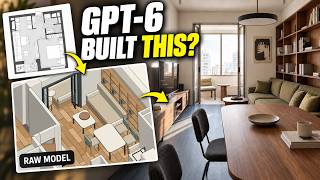
In another test, Space Money Alpha was given a single image of a houseplant in an apartment, connected to Blender, and asked to recreate the entire apartment in 3D.
After about an hour, it produced:
- A full 3D apartment scene, not just the plant.
- A reasonable reconstruction of the floor plan inferred from the image.
- Detailed modeling of furniture and spatial layout based on the reference photo.
This kind of image‑to‑3D workflow is still bleeding edge, so seeing a free, anonymous model handle it reasonably well is notable.
Building a full equity research app from one prompt
Space Money Alpha also showed strong full‑stack application skills. In one test, it was asked—via OpenCode with max reasoning—to build a complete equity research app from a single prompt.
The resulting app could:
- Pull live market data for a given ticker or company.
- Generate performance charts.
- Identify and display competitors.
- Fetch and surface SEC filings and recent corporate events.
- Summarize key risks and generate bull, base, and bear scenarios.
- Wrap everything in a clean, responsive UI.
Most impressively, the model figured out a lot of the details on its own—from where to source financial data to which competitors to include—without being micromanaged across multiple prompts. It took time, but it did all of this for free.
More 3D and front-end design examples
Beyond the big headline projects, Space Money Alpha has been used to generate several other high‑quality front‑end and 3D experiences:
- 3D front-end landing pages: It can combine tasteful typography, modern layout, and 3D elements into cohesive marketing pages.
- Complex UI states and interactions: It doesn’t just output static HTML—it wires up state, animations, and component logic.
- SVG-heavy interfaces: It frequently uses SVG for crisp icons and logos, showing a solid grasp of real‑world web dev practices.
While not perfect and sometimes buggy, the overall quality is high enough that many developers could use its output as a serious starting point rather than a throwaway demo.
Performance trade-offs: speed vs reasoning
Space Money Alpha’s behavior depends heavily on how much reasoning you ask for:
- Normal reasoning modes
- Very fast responses.
- Great for everyday coding, smaller components, and quick experiments.
- Max reasoning
- Much longer wall‑clock times (often tens of minutes for big tasks).
- Higher quality, more detailed, and more faithful to complex prompts.
- Still high token throughput, but more time spent planning and thinking.
If you’re exploring the model, it’s worth starting with normal reasoning for quick feedback, then switching to max reasoning only for large, important projects where quality matters more than speed.
How to access Space Money Alpha
For now, Space Money Alpha is available through:
- OpenRouter: You can call it like any other LLM via API or compatible front‑ends.
- OpenCode: Ideal for coding workflows, especially when paired with agents or IDE integrations.
Because it’s still in a free preview phase, there’s a strong incentive to experiment with it now—especially for web development, 3D experiences, and complex coding workflows that would be extremely expensive to run on frontier models like GPT‑6 Astra.
Why this stealth model matters
Space Money Alpha is one of the most intriguing anonymous models to appear so far. It combines:
- Frontier-level web dev and 3D capabilities.
- A massive 1M-token context window.
- Multimodal reasoning over images and video.
- High token throughput, especially impressive on large codebases.
- Completely free access during its preview.
We still don’t know who’s behind it or where it will land in the broader ecosystem of GPT‑6, Gemini, Claude, and other frontier models. But based on early tests, it’s already a serious option for developers who want powerful, low‑cost tooling for web, 3D, and complex app development.
If you work with code, 3D, or interactive front‑ends, Space Money Alpha is absolutely worth trying while it’s still open and free.







Comments
No comments yet. Be the first to share your thoughts!