
AI 3D just leveled up: UVs, 4K meshes, smart splitting and more
AI for 3D is evolving so quickly that long-standing pain points like UV unwrapping, low-res meshes, and clunky asset prep are finally getting real solutions. From 4K mesh generation to AI-powered UVs and object splitting, the 3D pipeline is starting to look very different.
Meshy 7.1 brings 4K meshes and extreme detail
Meshy 7.1 introduces one of the biggest upgrades in AI 3D generation so far: Ultra 4K mesh resolution with up to around 80 million polygons before simplification.
Until now, most text-to-3D or image-to-3D tools effectively topped out around 1K–2K resolution. That was already usable for concepting, but it often fell short for 3D printing, displacement maps, or high-end close-ups. With Meshy’s Ultra 4K mode, the detail level jumps noticeably.
Side-by-side comparisons show much sharper scales, surface patterns, and ground detail, all while staying relatively clean. Meshy also claims it has improved its upscaling so you get more detail without introducing extra noise—a common issue when pushing resolution higher.
Ultra 4K generations cost more credits (around 35 credits in one test), but the meshes are dense enough to serve as high-quality sources for:
• 3D printing
• Displacement or normal map baking
• High-poly to low-poly workflows in traditional 3D software
Among current 3D AI generators, Meshy now positions itself as one of the leaders in raw geometric detail.
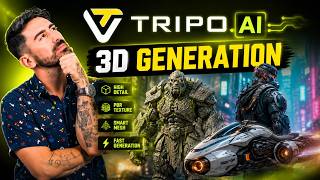
Tripo Smart UV: AI UV unwrapping that actually works
UV unwrapping has been one of the most painful steps in any 3D pipeline. Tripo’s new Smart UV feature is the first AI-based UV tool that genuinely looks production-ready for many use cases.
Smart UV is fast, relatively affordable, and supports both organic and hard-surface models. For around 20 credits you can generate up to four UV variations and pick the best one. In tests across different types of objects, the unwraps were reportedly "99% there" most of the time, which is a huge leap compared to earlier attempts.
Compared to alternatives like Hunyuan 3D Studio’s UV features, Tripo’s solution is more stable, dramatically faster (not 10 minutes per run), and feels much closer to something you can drop into a real production workflow.
Alongside Smart UV, Tripo also pushed its P2 model out of beta. The new P2 generates noticeably better low-poly meshes, making Tripo a strong candidate for game development workflows where clean topology and usable UVs are essential.
WorldSplat turns Gaussian splats into usable 3D scenes
Gaussian splatting has become a powerful way to capture real-world scenes from video or photos, but turning those splats into usable 3D assets has been tricky. WorldSplat tackles this by extracting watertight 3D objects directly from 3D Gaussian splats.
This is especially useful for:
• Interior captures (offices, living rooms, sets)
• On-location scans you want to rebuild digitally
• Quickly reconstructing environments for virtual production or games
WorldSplat can detect and extract individual objects like couches, tables, and other props as separate meshes. In one office example, it reconstructed 678 individual objects, each as a clean, watertight mesh suitable for use in 3D software or game engines.
The results can be imported into tools like Unreal Engine, where you get a full scene with separable assets and proper camera setups. Under the hood, WorldSplat builds on Trellis 2 and mixes techniques from Pixar’s Trellis work and Dino v3 to get from splats to objects.
GPT-6 Astra can now help animate 3D characters
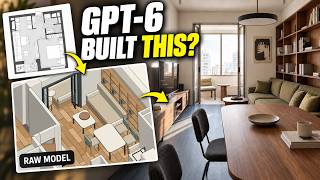
GPT-6 Astra isn’t just about text or code—it’s already showing surprising strength in 3D animation tasks. Users have demonstrated Astra generating animations for complex creatures, including multi-legged characters like scorpions, as well as humanoids.
Compared to earlier models like GPT-4.5 (often referred to as "fabl 5.1" in the transcript), the gap in animation capability is significant. Astra can:
• Generate plausible motion for non-human rigs
• Help design animation logic and constraints
• Work with external libraries and APIs to output usable animation data
The best results come from combining Astra with the right tools: feeding it rig information, using dedicated animation libraries, and wiring it into a custom workflow or AI workspace. If you’re already automating parts of your work with AI, it’s worth looking at how Astra can fit into a broader automation stack—similar to how people are using systems like Claude with tools such as Hyperframes for video, as shown in this end-to-end AI video editing guide.
Kai Ninja: splitting Trellis 2 meshes into separate parts
One of the biggest limitations of many image-to-3D models, including Trellis 2, is that they output a single combined mesh. That’s fine for static renders, but not great if you want moving parts, separate materials, or modular design.
Kai Ninja is a new approach built on top of Trellis 2 that takes a single image and generates a multi-part 3D model. For example:
• A chair becomes 15 separate pieces (legs, seat, backrest, etc.)
• A car is split into meaningful components like body, wheels, and windows
• A microwave gets separate doors, handles, and main body
This makes it far easier to animate, rig, or customize parts later. The model isn’t publicly released yet, and the licensing or monetization model is still unknown, but it’s a clear sign of where things are heading: AI that doesn’t just give you a mesh, but a structured, editable asset.
Snap3D: another take on part-based 3D from a single image
Snap3D explores a similar idea to Kai Ninja: generating full 3D scenes from a single image and then splitting them into separate parts.
The technique works by first generating a base 3D shape (for example using a model like Hunyuan 3D 2.1) and then applying a custom method to segment and reconstruct the object into multiple components. The research even covers generating connectors between parts, which is particularly useful for 3D printing assemblies that need to snap or slot together.
If you’re interested in the technical side, the authors provide a paper and demo video showing how they go from image, to 3D, to structured, printable parts.
Tencent’s Miura 3D: a quieter release with modest gains
Tencent has quietly released a new 3D AI model called Miura 3D, available through the Miura Tencent Design platform and Tencent Cloud API.
On paper, Miura 3D is meant to be a next-step model following Hunyuan 3D. In practice, early tests suggest only modest improvements, mainly in texture quality. When compared with leaders like Tripo, Meshy, or other frontier 3D generators, Miura doesn’t yet stand out in a major way.
Given Tencent’s resources, many were hoping for a big leap—something like a Hunyuan 3D v4 that would clearly surpass existing tools. For now, Miura 3D looks more like an incremental update than a disruptive new model.
HKTex: textures without UVs using heat kernel methods
While tools like Tripo Smart UV are making UV unwrapping easier, some researchers are trying to remove UVs from the equation entirely. The HKTex paper (short for Heat Kernel Textures) proposes a way to store texture information directly on the surface of a 3D model without needing a traditional UV map.
Instead of flattening a mesh to 2D space and painting on it, HKTex defines textures intrinsically on the surface. The goal is to match the visual quality of UV-based texturing while skipping the entire unwrapping step.
If approaches like HKTex mature, they could become a natural fit for AI-driven 3D workflows where meshes are generated on the fly and UVs are more of a legacy constraint. Combined with how fast 3D AI is evolving, it’s not hard to imagine a future where most artists rarely touch manual UVs.
This direction echoes a broader trend across AI tooling: moving away from tedious setup work and toward higher-level, intent-based control. You can see similar patterns in other areas, like how AI is starting to handle entire video workflows in tools covered in this look at Google’s free AI video generator.
What this means for 3D creators
Put together, these updates paint a clear picture of where 3D AI is heading:
• Higher fidelity: 4K meshes and 80M-poly models are becoming normal for source detail.
• Less grunt work: UV unwrapping, object splitting, and scene reconstruction are being automated.
• Smarter animation: models like GPT-6 Astra can already assist with complex motion generation.
• New foundations: research like HKTex hints at a future where core concepts like UVs may be replaced.
If you work in game dev, VFX, 3D printing, or virtual production, it’s a good time to start experimenting. The tools are still early, but the direction is clear: more automation, more structure, and more freedom to focus on creative decisions instead of technical busywork.



Comments
No comments yet. Be the first to share your thoughts!