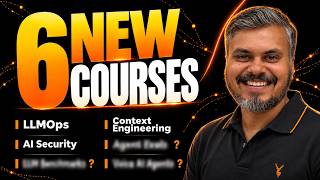
New CampusX courses for the AI engineer roadmap
The AI world has been moving at breakneck speed since the rise of large language models (LLMs) like ChatGPT. New tools, libraries, and buzzwords show up almost every week, and it’s getting harder for developers and learners to decide what to actually focus on.
Instead of chasing every new trend, one practical way to stay relevant is to build skills around a clear role: the AI engineer. That’s the direction CampusX has taken with its new set of courses—each one mapped to a structured AI engineering roadmap.
The focus: becoming an AI engineer
The central idea behind these new courses is simple: companies increasingly need engineers who can design, build, deploy, and maintain LLM-powered applications at scale. Titles may vary—AI engineer, LLM engineer, founding engineer (FE), agent engineer—but the core skill set is similar.
To support this, CampusX has created an AI Engineering Roadmap with around 15–16 levels. The goal is that, by following these levels, a learner can move from fundamentals to production-grade AI systems in a structured way. The six new courses sit at specific levels of this roadmap and are meant to fill important skill gaps that keep showing up in real-world AI work.
How the courses are built
All new courses are first run live with a group of paying members called Insiders (the top tier of the CampusX One membership). These live sessions provide instant feedback—what’s confusing, what’s missing, what needs more depth.
After the live run, the recordings are edited, refined, and packaged into self-paced courses. This way, the final course you see has already gone through multiple iterations with real learners.
1. LLMOps: taking LLM apps to production
What it is: LLMOps is to large language models what MLOps is to traditional machine learning. It’s about managing the full lifecycle of LLM-based applications—from development to deployment, monitoring, and scaling.
Course approach: The course teaches LLMOps by walking through two concrete application types:
A Retrieval-Augmented Generation (RAG) application
An agentic AI application
You learn the same lifecycle twice—once for a RAG app and once for an agent—so the concepts stick and you see how they generalize.
Key topics covered:
The LLMOps lifecycle and how it compares to classic MLOps
Prompt management and system prompts
LLM evaluations and metrics for production readiness
Experiment tracking
Safety and security considerations
Production engineering: Docker, FastAPI, CI/CD, deployments
This is a long, in-depth course with over 60 hours of edited content, aimed at learners who want to confidently talk about and implement LLMOps in interviews and on the job.
Price: ₹3500 list, with a Diwali launch discount of ₹1000 (₹2500 effective price for a limited time).
2. Context engineering: working within the context window
Every LLM has a context window—the maximum number of tokens (roughly words and symbols) it can handle at once. Even with modern models offering up to around a million tokens, context is still finite and expensive. Poor context management leads to higher costs, slower responses, and worse answers.
The context engineering course is all about understanding and managing that constraint effectively.
What you learn:
What “context” actually means in the architecture of an LLM
Technical concepts like KV (key-value) caching
How to design and manage context in different types of applications
Practical scenarios covered:
Context strategies for RAG applications
Managing tool outputs in agentic workflows so they don’t bloat the context
Using the Model Context Protocol (MCP) and handling its context flow
Integrating and managing memory with agents or RAG systems
Context compression techniques
This isn’t a flashy topic, but it’s one you’ll use in almost every serious LLM project.
Price: ₹1500, with Diwali discounts applied.
3. AI security and guardrails: keeping AI systems safe
As AI agents and LLM apps move into production, security incidents are becoming more common—prompt injection, data exfiltration, unsafe tool use, and more. Enterprises are starting to take AI security as seriously as traditional application security.
This course is a practical introduction to securing AI systems and adding guardrails, without getting lost in overly academic theory.
Course structure:
Part 1: Realistic case studies and scenarios showing how AI applications can be unsafe.
Part 2: Securing a RAG application—attack surfaces, defense strategies, and where to place guardrails.
Part 3: Securing agentic applications—how agents can be attacked and how to safeguard them.
Industry-relevant topics:
Threat modeling for AI systems
Frameworks and patterns emerging as de facto standards
Practical guardrail design for real-world apps
If you’re interested in how enterprises are thinking about securing AI agents, this pairs nicely with broader discussions like securing the enterprise in the age of AI agents.
Duration: Around 10–12 hours.
Price: ₹2000, with around 30–34% Diwali discount.
4. Agent evals: evaluating agentic applications
Evaluation is a core part of any serious AI workflow. CampusX previously released material on LLM evaluations and RAG evaluations. This new course extends that work into the world of agents.
What this course includes:
All the Agentic Evals content (around 6 hours)
Notes and resources for both LLM Evals and Agent Evals in one place
This is more of a “bundle and continuation” course than a standalone from-scratch program. It’s aimed at learners who already understand basic eval concepts and now want to measure and debug agent behavior more systematically.
Price: ₹1000, with launch discounts applied.
5. LLM benchmarks and leaderboards: understanding the scoreboards
Every time a new model launches, you see headlines like “Model X beats everyone on benchmark Y.” But what do those benchmarks really mean? Who designs them? How do they evolve? And how should you, as an AI engineer, interpret them?
This course is designed to answer those questions by walking through the history and structure of the most important benchmarks across domains.
How the course is structured:
Benchmarks are covered in chronological order—how one benchmark became popular, then obsolete, and what replaced it.
Different domains are separated so you can see how evaluation evolved in each area.
Benchmark categories covered:
Knowledge benchmarks
Reasoning benchmarks
Math benchmarks
Coding benchmarks
Instruction-following benchmarks
Long-context benchmarks
Agentic AI benchmarks
Multimodal and safety benchmarks
Leaderboards: how they work and how to read them
Alongside the course, there’s also a public website listing 50+ benchmarks organized by domain. Even if you don’t take the course, that site can be a handy reference. For those who do, the course adds narrative, history, and context—helping you make sense of model announcements like those covered in roundups such as recent multi-model AI update overviews.
Duration: Around 12–15 hours.
Price: ₹800, with Diwali discount.
6. Voice AI agents: going beyond text
Most AI engineering content focuses on text (and sometimes images), but voice is quickly becoming a major interface for AI—think customer support bots, voice-enabled tools, and real-time assistants.
The Voice AI Agents course is a short, hands-on introduction to building such systems.
Course structure:
Module 1: The Voice AI landscape—where voice agents are being used, which industries are adopting them, and what technologies are available.
Module 2: Building a Voice AI agent using no-code tools, with ElevenLabs for speech-related capabilities.
Module 3: Building a coded Voice AI agent using Pipecat, showing how to wire everything programmatically.
This gives you both a quick no-code path and a deeper engineering-focused path.
Duration: 6–7 hours.
Price: ₹600, with launch discounts.
How these courses map to the AI engineering roadmap
The new courses aren’t random—they plug into specific levels of the CampusX AI Engineering Roadmap:
Level 6: Context Engineering → covered by the Context Engineering course.
Level 8: AI Security → covered by the AI Security & Guardrails course.
Level 10: LLMOps → covered by the new LLMOps course.
Audio and multimodal sections → partially covered by the Voice AI Agents course and related modules in Multimodal 101.
Earlier in the year, CampusX also released courses like Prompt Engineering (Level 3) and an Advanced Track (Level 4), all aligned with the same roadmap.
What’s coming next
Over the next three months, the focus is on three more roadmap-aligned courses:
LLM 101: Understanding LLMs technically from an AI engineer’s perspective—not just theory, but how to work with them in practice.
AI System Design: Designing full AI systems end-to-end, including components, data flow, infra, and trade-offs.
Fine-tuning: A dedicated course on fine-tuning models, which is in high demand.
In the three months after that, the plan is to focus heavily on projects—building many real-world applications so learners can put their skills into practice. The broader goal is to cover the entire roadmap within about six months.
Diwali discounts on the new courses
Because these courses are launching around Diwali, there are introductory discounts across the board:
LLMOps: ₹3500 → ₹2500 (₹1000 off)
Context Engineering: ₹1500 with ~30–34% off
AI Security & Guardrails: ₹2000 with ~30–34% off
Agent Evals: ₹1000 with discount
Benchmarks & Leaderboards: ₹800 with discount
Voice AI Agents: ₹600 with discount
The general pricing philosophy is to keep courses affordable while still reflecting the effort and depth involved—especially in long-form courses like LLMOps.
Diwali offers on older CampusX courses
In addition to the six new launches, there are Diwali discounts on earlier flagship courses as well. On the CampusX website, you’ll find a flat 25% off on:
DSMP (data science / machine learning program)
DAMP and other analytics or ML-focused programs
Older specialized courses like DSA for AI, Explainable AI, and more
Notes and supplementary material
If you were planning to pick up multiple foundational courses, this period is positioned as a good time budget-wise.
CampusX One membership: access to all courses
For learners who want long-term access rather than buying individual courses, there’s also a membership model called CampusX One. It comes in three tiers, each with different levels of access and live interaction.
Insiders tier (top tier)
Price: ₹20,000 list, currently ₹17,000 with Diwali discount.
What you get:
Access to all current courses and all new courses released in the next two years
Live access to course creation sessions (you attend while courses are being built)
Live recordings of YouTube content before it’s published
Regular sessions on the latest AI developments and industry changes
This tier is aimed at learners who want the closest interaction with the teaching team and want to influence course direction through feedback.
Aspirant tier (mid tier)
Price: ₹15,000 with Diwali discount.
What you get:
Access to all current and upcoming courses for the next two years
No live component—only the edited versions of courses and content
This is for learners who don’t need live interaction but want full course coverage at a predictable cost.
Learner tier (entry tier)
Price: ₹10,000.
What you get:
Access to 28 existing courses created up to June 2026
Newly launched and future courses (including the six in this article) are not included
This tier is meant for learners who mainly want the existing catalog and are less concerned with the newest roadmap courses.
If you’re unsure which option fits you best or have questions about inclusions, you can reach out to CampusX support via email and even request a callback.
Staying focused in a noisy AI landscape
With new AI tools, models, and libraries emerging almost every week, it’s easy to get distracted by short-lived buzzwords. CampusX itself experienced this when they invested heavily in a course around a then-hyped agent library, only to see interest drop as the ecosystem moved on.
The new strategy is to focus on durable skills tied to the AI engineer role: LLMOps, context management, security, evaluation, benchmarks, and multimodal agents like voice. These are the kinds of capabilities that will stay relevant even as specific tools come and go.
If your goal is to become an AI engineer, the idea is to move level by level through the roadmap, picking courses that match your current stage—rather than trying to learn everything at once. With the Diwali discounts and membership options, this might be a good moment to choose the next step that fits your learning plan.
However you approach it, the key is to stay consistent, keep shipping small projects, and build skills that map to real-world roles—not just the latest trend.






Comments