Why Grok 5 could be Elon Musk’s biggest AI bet yet
Elon Musk’s AI company xAI is betting big on its next model, Grok 5. On paper, it’s a huge leap: a 6-trillion-parameter system, trained on unique SpaceX data, designed for real-time video understanding and powerful AI agents. Musk has even said it’s the first time he sees a real chance—around 10%—of reaching artificial general intelligence (AGI).
Grok 5 isn’t out yet, and expectations are sky-high. But even if it only delivers part of what’s promised, it could change xAI’s place in the AI race. Here’s what Grok 5 is supposed to do, why it’s so hard to launch a frontier model right now, and how you should judge it when it finally arrives.
What Grok 5 is supposed to be able to do
Musk has described Grok 5 as the first model from xAI that has a “non-zero” shot at AGI. He estimates that chance at about 10%, which still implies a 90% chance that it doesn’t happen—but for the person running the company, that’s a strong statement.
Under the hood, Grok 5 is meant to be very different from earlier Grok versions in four key ways: size, efficiency, data, and multimodality.
A 6-trillion-parameter model
Musk says Grok 5 is built on a 6 trillion parameter model, compared with the 3 trillion parameter base used for Grok 3 and Grok 4. Parameters are the internal “dials” an AI adjusts while it learns. More parameters don’t automatically make a model smarter, but they usually give it more capacity to store knowledge and capture complex patterns.
At this scale, Grok 5 would be one of the largest AI models ever trained, assuming xAI can successfully finish and deploy it.
“Intelligence per gigabyte”
Musk has also emphasized a different metric: intelligence per gigabyte and per unit of compute. In simple terms, this is about how much useful capability you can squeeze out of each unit of memory and processing power.
Why that matters: running giant models is expensive. If Grok 5 can deliver more capability per gigabyte than Grok 4, it could be cheaper, faster, and easier to scale in real products—even if it’s much bigger overall.
Better and more unique training data
According to Musk, Grok 5 is trained on much higher-quality data than earlier versions. One of the most interesting pieces of that data is SpaceX itself. Musk has said that a major Grok model would be trained on the entire history of SpaceX: launch logs, engineering notes, manufacturing data, and more.
That kind of proprietary, real-world technical data is something other labs simply don’t have. If used effectively, it could make Grok 5 especially strong at engineering, physics, and systems-level reasoning—areas that could tie into Musk’s broader ambitions in robotics and automation. For more context on why this kind of compute and data advantage matters, see this breakdown of how a few labs could end up controlling most of the world’s AI compute.
Multimodal from day one
Grok 5 is designed to be multimodal from the start. That means it’s not just a text model—it’s built to understand text, images, audio, and video in one unified system.
Musk has highlighted one capability in particular as essential: real-time video understanding.
Why real-time video could be a big deal
Most current AI models can handle static images and short video clips. Musk claims Grok 5 will go further, understanding real-time video streams as they happen. In his view, if an AI can’t understand live video the way humans do, it can’t reach true general intelligence.
If Grok 5 really can process and reason over live video, it unlocks a range of new possibilities:
Assistants that see what you see through your phone and help in real time.
Robots and drones that understand their environment more reliably.
Industrial and safety monitoring systems that can react to events as they unfold.
So far, none of the major labs have clearly demonstrated this kind of robust, real-time video reasoning in public products. If Grok 5 can do it well, it would be a genuine differentiator.
Why nobody is really out of the AI race
Right now, most people see the AI race as a three-way contest between OpenAI, Anthropic, and Google. Grok often gets left out of that conversation because its current models lag behind on popular benchmarks.
But the last year has shown how quickly the leaderboard can flip. Google, for example, was widely seen as slow and behind. Then, within about a month, it launched two new top-tier models, Gemini 4 Argon and Gemini 4 Carbon, and climbed to the top of one of the most respected independent rankings.
In an environment where labs release new frontier models every few weeks, no one is permanently ahead or behind. A single strong launch can push a lab from “written off” to “world leader.” The question is whether Grok 5 can be that launch for xAI.
How xAI plans to win: hardware and data
Musk’s argument for why xAI could catch up—or even lead—comes down to two things: hardware scale and real-world data.
He argues that most big ideas in AI spread quickly between labs. Researchers move, papers get published, and within about six months, everyone knows the core tricks. That means the long-term advantage comes from who can scale compute and data fastest, not who has a single secret algorithm.
Colossus and massive compute
xAI is now tied closely to SpaceX, which has built enormous computing infrastructure. Its Colossus supercomputer in Memphis reportedly went from idea to operational in just 122 days. On a recent earnings call, SpaceX said it had around 1.4 gigawatts of AI computing power online, targeting 2 gigawatts by the end of this year and 10–15 gigawatts by 2027.
For context, 1 gigawatt is roughly the output of a large power plant. SpaceX spent nearly $20 billion on capital expenditures in a single quarter, mostly on AI infrastructure, and even rents out compute to other labs, including Anthropic.
Musk describes xAI’s strategy as following the “Tesla path”: collect massive amounts of real-world data, throw enormous compute at it, and keep iterating until the system works at scale.
Where Grok stands on benchmarks today
To understand what Grok 5 needs to achieve, it helps to know where things stand now.
One of the best-known combined rankings is the Artificial Analysis Intelligence Index. It aggregates many independent tests covering reasoning, coding, science, and math. On the latest version, Google’s Gemini 4 Carbon sits at the top with a score of 59, with the best models from Anthropic and OpenAI just a couple of points behind.
Grok is currently behind that group. Grok 4.7 scored 46 on the previous version of the same index, while the top models were around 53. On an AI agent coding benchmark called Terminal Bench—which measures how well an AI can actually operate a computer and solve coding tasks—Grok 4.7 scored about 26%, compared with roughly 60% for OpenAI’s GPT-6 Astra.
So there’s a real gap for Grok 5 to close. Musk’s public statements suggest he expects far more than that.
Musk’s expectations for Grok 5
Musk has said Grok 5 could be “the smartest AI in the world by a significant margin on every metric.” He’s also claimed it might score nearly perfectly on a notoriously hard benchmark called Humanities Last Exam (HLE), and even point out errors in the questions.
He’s also suggested that Grok 4.9 (the model before Grok 5) should already be in the same class as top models like GPT-6 Astra and Claude Fable. If that’s the bar for 4.9, Grok 5 is expected to be clearly ahead of today’s best systems.
Realistically, for Grok 5 to be taken seriously as a frontier model, it probably needs to:
Score around 60 or higher on the latest Artificial Analysis Index, putting it in the top tier.
Close much of the gap on agentic coding tests like Terminal Bench.
Show standout performance on multimodal tasks, especially involving images, audio, and video.
Musk summarized his expectations with a simple line: “Grok 5 may be better than anything. We shall see.” That “we shall see” is doing a lot of work.
Why releasing a frontier model is getting harder
Even with huge compute and big ambitions, shipping a top-tier AI model is harder than ever. There are several reasons.
The target keeps moving
Training a giant model can take months. During that time, rivals are also training and releasing new systems. You might start training expecting to be number one, only to find that by the time you’re done, multiple stronger models have launched.
As the Google example shows, the top of the leaderboard can move by nearly ten points in a month. Grok 5 isn’t competing with the models that existed when training began—it’s competing with whatever is live on its launch day.
Reinforcement learning takes time
After the initial training phase, models go through reinforcement learning and other fine-tuning steps. That’s where they learn to follow instructions, solve tasks, use tools, and behave safely. This phase can take longer than expected and often determines how “polished” a model feels.
Musk has said that xAI rebuilt its training stack in C++, largely with help from the SpaceX Starlink software team. That kind of overhaul can pay off in the long term but usually adds delays in the short term.
Costs and opportunity cost
Training a 6-trillion-parameter model requires staggering amounts of compute. Every extra week of training is another week where those chips can’t be used to serve paying customers or train follow-up models. Labs have to balance pushing the model further with getting it out the door.
Benchmarks are getting tougher and more private
Benchmark creators are also changing how they test models. The latest Artificial Analysis Index, for example, has about 60% of its questions hidden from labs. That makes it much harder to “train to the test,” intentionally or not.
The result: it’s no longer enough to look great on a chart built from public questions. Models now have to perform on unseen, private tasks as well.
Sky-high expectations
Finally, expectations matter. When you publicly promise that your next model will be the smartest AI on the planet “by a significant margin on every metric,” releasing something that’s just “very good” becomes a problem.
That pressure likely explains why Grok 5 has slipped from an initial target in the first quarter of this year to a new target before the end of 2026. It’s frustrating, but if the alternative is a rushed, underwhelming release, waiting may be the better choice.
Benchmaxing: when benchmarks mislead
There’s a growing concern in the AI world about “benchmaxing”: optimizing models to look great on well-known benchmarks, without actually being much better in real-world use.
Musk has said xAI is not chasing benchmark glory. In one post, he wrote: “We’re not optimizing for benchmarks, and I really don’t care how Grok does on those, but it will be incredibly useful.”
That’s easy to say when you’re behind on the charts, but there are reasons to take it seriously.
The Kimmi K example
Consider Kimmi K 3.1 Pro, a model from Chinese lab Moonshot AI. On public benchmarks, it looked spectacular—scoring over 65% on Terminal Bench and ranking fourth on the previous Artificial Analysis Index, close to the top closed models.
But when the index switched to a new version with mostly private questions, Kimmi K 3.1 Pro dropped from fourth to ninth. The gap between it and the best closed models widened significantly. There’s no proof Moonshot trained on the test data, but many observers saw this as a case of benchmaxing being exposed.
Grok’s surprising strength on private tasks
Interestingly, Grok shows the opposite pattern. AI writer Adam Holta shared data from Artificial Analysis comparing public coding tasks with private ones. On public coding tasks, Grok 4.7 came last out of nine models. On private tasks, it jumped to seventh, ahead of Claude Sonnet 5.5 and Gemini 4 Argon.
In other words, Grok looks worse on famous public tests than it actually is on unseen work. If xAI really is optimizing for usefulness instead of charts, Grok 5 might not dominate the launch-day marketing slides—but it could perform better where it matters: on private benchmarks and real workloads.
Why the agent harness might matter more than the model
When people compare AI systems, they usually focus on the model itself—the “brain.” But when you actually use AI to get work done, you’re interacting with more than just the model. You’re using what’s often called the agent harness.
The agent harness is all the software wrapped around the model: tools, memory, browsing, file access, code execution, and the logic that lets the AI try something, check the result, and iterate.
In practice, the harness can make as much difference as the underlying model. In one study from Princeton, the same base model scored 42% on a task with one harness and 78% with a different harness—nearly doubling performance without changing the brain at all.
Sometimes, simpler is better. The company Vercel reportedly removed around 80% of the tools available to its AI agent and saw its success rate go up, not down. This has led to a new focus on “harness engineering” as a discipline in its own right.
xAI’s growing agent ecosystem
xAI and SpaceX have been quietly building a strong agent ecosystem around Grok:
Cursor: SpaceX acquired Cursor, one of the most popular AI coding environments, for a reported $60 billion. Cursor is essentially a top-tier harness for coding, with deep integrations into developer workflows. After OpenAI stopped providing models to Cursor, it became even more tightly linked to Grok, with SpaceX saying Cursor will use its largest compute clusters to improve Grok-based products.
Grok Build: xAI offers tools aimed specifically at developers, giving them ways to embed Grok into their own apps and workflows.
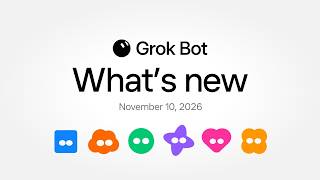
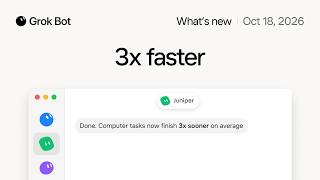
Grokbot: xAI’s work-focused assistant is designed as an agent that can take on complete tasks—emails, research, sales outreach—rather than just answering questions in a chat box.
When Grok 5 launches, it won’t just be a model on a leaderboard. It will be wired into Grokbot, Cursor, and the X platform, putting it in front of hundreds of millions of potential users. How good it feels inside those products may matter more than any single benchmark score. For a deeper look at how Grok fits into Musk’s broader ecosystem, see this analysis of why Grok might be Tesla’s real “ChatGPT moment”.
Grokbot’s rapid growth
One of the most interesting signals around xAI right now isn’t a benchmark—it’s usage.
Grokbot, xAI’s agentic assistant for work, launched in beta in August. By mid-September, xAI reported around 418,000 weekly users. Third-party estimates from SimilarWeb suggest daily users climbed from about 155,000 in late September to 450,000 in mid-October, and then to over 600,000 by the end of October, with 16 straight days of growth.
On a recent SpaceX earnings call, president Gwynne Shotwell reportedly said Grokbot had reached 800,000 paying weekly users—more than double the month before.
The most striking part: Grokbot has no free tier. Every one of those users is paying at least $30 per month. Musk has said “agentic demand is growing faster than I’ve ever seen anything grow.”
On top of that, Grok’s AI features on X reportedly reached around 117 million monthly users back in March. Grok already has reach; Grokbot is about turning that reach into real, recurring revenue for AI that does work.
Most of SpaceX’s AI revenue today still comes from renting out compute, not subscriptions. But the direction of travel is clear: more people are paying for AI agents that handle tasks end-to-end, not just chat.
Musk has said most Grokbot requests will soon run on a highly optimized version of Grok 4.8, and later on Grok 5. That means the fastest-growing xAI product is about to get a major upgrade—and then potentially an even bigger one.
What to watch when Grok 5 launches
If you’re trying to decide whether Grok 5 really matters, here are the key things to pay attention to once it’s out.
1. Independent rankings and private tests
Look at how Grok 5 performs on independent benchmarks, especially those with private questions like the latest Artificial Analysis Index. A score around 60 or higher would put it in the top tier alongside Gemini, GPT, and Claude.
2. Real-time video capabilities
Does Grok 5 actually deliver on real-time video understanding? Can it reason about live streams, not just static images or short clips? If xAI can demonstrate this convincingly, it could be a major differentiator for robotics, AR, and real-world assistants.
3. Agentic work and coding
Watch how Grok 5 performs on agent benchmarks like Terminal Bench and how it feels inside tools like Grokbot and Cursor. Does it actually finish more tasks, write better code, and handle complex workflows more reliably?
4. Launch timing
Will Grok 5 ship before the end of 2026, as now promised? Delays are common in frontier AI, but the longer it slips, the harder it becomes to leapfrog rivals that are also moving fast.
5. The competition’s next moves
Grok 5 won’t launch into a static market. By the time it arrives, we’re likely to see new versions of Gemini, GPT, Claude, and more. The real question isn’t whether Grok 5 can beat today’s models—it’s whether it can beat whatever exists on its launch day.
How you should judge Grok 5
For everyday users, the best way to judge Grok 5 won’t be launch-day charts or hype. It will be how it performs inside the tools you actually use.
Does Grokbot save you time? Does Cursor with Grok 5 help you ship code faster and with fewer bugs? Does it handle complex, multi-step tasks reliably, not just answer trivia or pass exams?
This applies to all AI models, not just Grok. Benchmarks are useful, but they’re not the whole story—especially as tests get more private and as harness engineering becomes just as important as model quality.
The bottom line: is Grok 5 too late, or just in time?
Right now, Grok is behind the leaders on most public rankings, and Grok 5 has already missed its first launch window. It’s easy to assume xAI has lost the race.
But the last year has shown that nobody is ever really out. Google went from “too slow” to “number one” in about a month. xAI has some assets almost no one else has: massive compute, unique SpaceX data, a world-class coding harness in Cursor, and an AI assistant whose paying users are more than doubling month over month.
If Grok 5 delivers even part of what’s been promised—a 6-trillion-parameter model, real-time video understanding, much better tool use, and strong performance inside fast-growing products like Grokbot—it could push xAI back to the front of the pack. If it doesn’t, the bar will keep moving, and catching up will only get harder.
Either way, Grok 5 is shaping up to be one of the most important AI launches to watch over the next few cycles. The smartest way to think about it: don’t judge it by the hype or the early charts. Judge it by what it actually does for you.




Comments
No comments yet. Be the first to share your thoughts!